Jing Masterminds: Aston Martin's Marek Reichman on Beauty that Lasts
Jing Daily presents Jing Masterminds — an exclusive interview series profiling today’s most iconic names in art, fashion, commerce and culture. Delving deep into their personal journeys, creative processes, business strategies and societal impacts, the series offers readers an intimate look at the lives and minds shaping our industries.
From the scent of leather and carbon fiber to a 28-year-old single malt, the carmaker’s creative chief Marek Reichman argues analog experiences matter more in a digital world.

Aston Martin is synonymous with James Bond and the upper echelons of British craftsmanship, and much of its reputation for building some of the world’s most beautiful cars is owed to Marek Reichman. As executive vice president and chief creative officer of Aston Martin Lagonda, he has overseen the marque’s defining models, including the DBS, the limited-run One-77, the flagship Vanquish Volante convertible and the Valhalla, a mid-engine plug-in hybrid supercar.
Since Glenfiddich’s partnership with Aston Martin began at the Formula 1 Las Vegas Grand Prix in November 2024, Reichman’s creative reach has extended into whisky. On November 4, Reichman joined Glenfiddich malt master Brian Kinsman for the global reveal of Glenfiddich 28 Years Old, a limited-edition single malt that the two brands billed as “born from two brands in perpetual motion.” For Reichman, the partnership is about shared values but also the multisensory experience of Glenfiddich whisky and Aston Martin cars: the scent of each and the depth of feeling they produce.
In London, Jing Daily sat down with Reichman to talk about why the collaboration makes sense now, how beauty and proportion outlast trends, what F1 has done for car culture and why owning a 28-year-old whisky means “you are tasting time.”
Why does the collaboration with Glenfiddich make sense for Aston Martin now?
Well, we are two like-minded brands. But whenever we enter a partnership, it should never be one plus one making two. It has to make three. The sum of the two brands needs to create something unique. We work in different sectors, but we stand for the same thing: the ultimate craftsmanship. The ultimate craft of making a whisky, the ultimate craft of making a car.
Collaboration is culturally more relevant now. Brands are migrating toward each other to create something new because the world is different. We have more information at our fingertips, so we’re discovering more and want to learn more, and consumers are looking for new and different things. They want a conversation about what they just bought or what they just did. The experiential world has changed. It could have worked in the past, but fewer people would have known about it. Now there are platforms that can talk about the relationship, share it and expand it.
And that’s only going to accelerate, because we’re in a digital world. The more we do outside of it matters: tasting the whisky, smelling the whisky, understanding how whisky is made. You can’t do that digitally. You can’t sense an Aston Martin’s visceral noise, sound and acceleration digitally. We can see it, but we want to experience it. So, now is the time for experiences that come together and create something unique for customers, because they’re seeking it.
What do you hope to achieve through collaborations like this one?
Personally, it’s about learning. People say I’m a master of my craft, but I’m learning every day from different sectors, different experts, people who are masters of their own craft. If I stop learning and growing, things come to a halt. Understanding the nuances of creating a whisky, where the heritage sits, what the unique ingredients are, what makes a Glenfiddich good: I can learn from that and apply it to myself and what my team does.
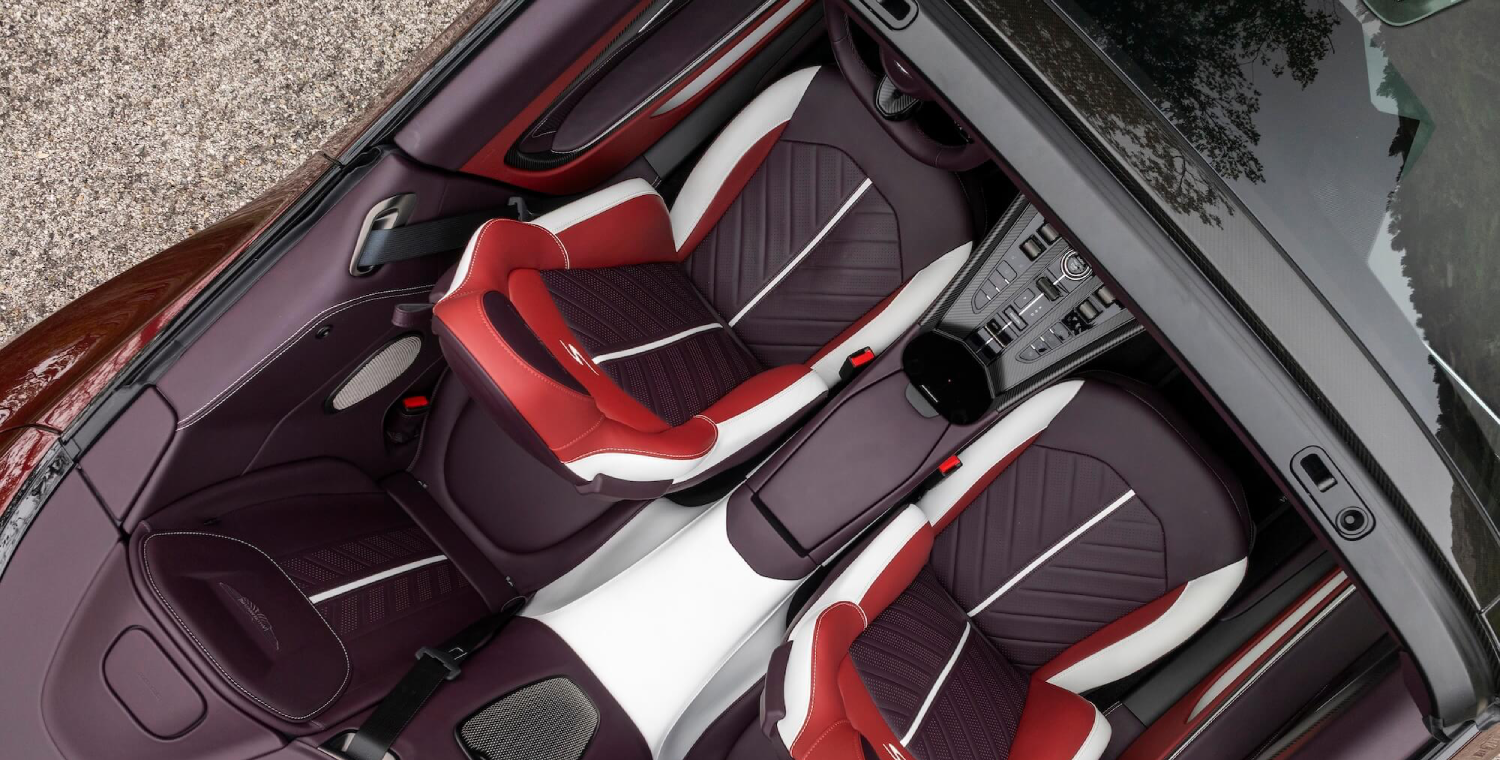
Equally, Glenfiddich can grow and understand what an Aston Martin is and what it takes, like what leather and carbon fiber smell like together. Nobody’s thought about that, because we all think of leather and wood, but actually we have more carbon fiber in our cars than wood. So what do leather and carbon fibre actually smell like? And how can we influence that? So many people get into our cars and go, “Oh my goodness.” And what do you do when you taste a whisky? You go, “Oh, that smells so good.”
How does art, design, and car design come together for you?
I would have to say desire: the desire to look at it, to own it, to be part of it. We make collectibles. We don’t make consumables. It’s like art: if you have a preferred artist and you commission something for yourself, there’s excitement and desire in getting there.
For me, a car is very much the same as a limited series of whiskies. A 28-year-old whisky took 28 years to make. When you own it, you are tasting time. As long as it has a meaning, something beyond what you’re looking at, there’s a passion in it for me. The value of our cars is exactly the same. It goes beyond what you just see.

What are your thoughts on the future of car design both in terms of aesthetics and practicality?
Right now, there are brands trying to challenge their own history. I don’t think they’re challenging design; they’re challenging their own history. And because of the digital world, people want analog.
As soon as you say you can only have digital music, what happens? LP and vinyl sales soar.
That’s where automotive design is. Consumers want something different. People who had posters on their walls as children of the cars of the 50s and 60s, or the 70s, 80s and 90s, all want to go back. People love them now, because they were the posters of their childhood.
At Aston Martin, I’m not going to say we are timeless, but we have a recognized theme of design, which is always based around proportion. Proportion is beauty, and you can’t argue with beauty. We’re hardwired to see something beautiful and go, “Wow.” What’s changed is technology: lighting technology, glass curvature technology. But ultimately, the beautiful proportion is what lasts. The DB5 from the 60s is still a beautiful car. Beauty will sustain and pass through everything.
My task is to make future collectibles, so a car that comes out today will still be a collectible car at a concours in 50 years’ time. There are a lot of design languages now that are trying to shock, and they’ll shock today but be gone tomorrow because they don’t have longevity. My principle is always: make it beautiful, and let the technology evolve around it. To that point, 96% of the cars we’ve ever made in our almost 114 years still exist. Because you don’t throw away something beautiful. With whisky, you can’t keep it, because you have to drink it. But you can keep the bottle.
What is the most interesting thing you have learned this month?
It might not be a week into November yet but so many.I learned that Iris by Googoo Dolls was written and recorded in 20 minutes.
Not everything takes a long time. But it took an expert 20 minutes. Those experts spent years and years perfecting their craft. It’s the same with me. I might sketch a car in an afternoon, but that’s taken 30 years of experience to understand what I want through discovery. It may seem quick, but behind the scenes is a long story and a struggle, because makers in any world are their own biggest critics, always trying to do better and more.
The expertise exists; it’s the immediacy of how you deploy it that took 20 minutes.
In terms of your work: what elements do you draw from culture, fashion, and art?
I have favorite artists, and architecture is an inspiration to me. The world of fashion I find fabulous because by its nature it’s fashion because it changes. But I tend to love brands with an appeal beyond the fashion of today, brands where you see people dressed in clothes from 20 years ago that look just as good as what’s just been shown on the runway.
Music is really important to me. Sound reacts with color and shape in my head. And seeing someone perform on stage or at a venue can be inspiring. But more than anything, it’s people: culture, travel, different places and different people. Conversation is just as important as something visually stimulating. You can learn something from the person sitting next to you on a bus, and that’s inspiration too.
How would you define genuine novelty in terms of car design?
MR: Genuine novelty is something that hasn’t been done before. It can be the smallest thing or the biggest part of a piece of art or design, but novelty is unique; it hasn’t been done. We can search and search for newness, and sometimes it’s in a millimeter. I’m always someone who says the details matter, because our eyes can see down to 40 micrometers. So newness can be as small as that, because we’ll see it.
What are your thoughts on F1’s cultural impact?
F1 was a rough-cut diamond in the beginning. People didn’t see the true diamond that it is. It was protected and not accessible for many years. Then, whether you credit Netflix or a change of governance, more people were allowed on the inside to understand it.
Now it’s as much about the personalities, the drivers, their teams, their home life, their happiness and sadness, as it is about two hours of driving around a circuit at the fastest possible speeds.
What are some unique developments/aspects of car culture in the past two years that you’ve noticed?
The culture of being involved in the making. In Los Angeles, you can go to a car garage, have a coffee, work from there and see someone working on a car or a motorbike being built. People want to see the process.
A lot of that has come through restomods: you see something go from A to B, how it looked before and how it looks now. There’s a plethora of companies doing that, like Chelsea Truck Company, Kahn Design and Brabus, who take the base and make it better.
You restore something and then reinvent it. It’s seeing how it’s done that has culturally changed, and people want to be embedded in that culture.
Particularly in London, there’s maybe less of a desire to own, but more of a desire to snap the car on the corner and post it on Instagram. A lot of those people don’t drive, but they’re fascinated by cars.