The trailblazing F1 collab that no one knows about
The author of bestselling watch book 'Drive Time' and our foremost authority on all things cars and watches-related, Aaron Sigmond, writes about the 1980s collaboration that would change the face of Formula One marketing forever: Formula Ferrari by Cartier.
.webp)
Cartier is having a moment. Specifically, Cartier watches are having a moment. Truth be told, they’ve had many moments, beginning with the opening decades of the twentieth century and the arrival of the maison’s Santos [1904] and Tank [1919] models. They were there again during London’s Swinging ’60s (still a family concern at the time, the company was split between Paris, London and New York City). Cartier was all over Manhattan’s “Fun City” scene in the ’70s, and everywhere in the Go-Go ’80s. It has now occupied center stage anew for the past year or so. It’s on its own these days, but for a moment it was part of a Franco-Italian duo: Cartier and Ferrari. Therein hangs a tale.
At various points over the past eight decades, the term “Ferrari watch” could have referred to any of a trio of timepiece categories. First, a gift or presentation watch personally commissioned, and typically presented, by Enzo Ferrari, “Il Commodore” himself.
Second were the then-accessible and aspirational white-label timepieces made by Longines and Cartier in the 1970s and ’80s, respectively, and more recently the Movado Group, but let’s not go there. Typically, these widely available timepieces had the prancing horse only on the dial and were not co-branded with the watch company. (There were exceptions, especially in the case of Longines.) The Longines and Formula Ferrari by Cartier collaborations nonetheless remain historically significant as groundbreaking non-automotive marketing and branding initiatives by Ferrari.
Finally, there have been (so far) five Swiss luxury-horlogerie maison Ferrari fine-watch joint ventures: with Girard-Perregaux (1994–2004), Panerai (2006-10), Cabestan Geneve (2010-11), Hublot (2011-20) and Richard Mille (2021-present).
At some point in the mid-’70s—exact dates are fuzzy—Ferrari (both man and company) had struck a trailblazing commercial watch venture deal with Longines. Alas, Longines’ glory days were long gone by then. So the tie-up was, for the most part, a collaborative, co-branded cash grab. (Enzo always needed funds to finance his racing pursuits; who could blame him? Likewise, the ’70s were tough on the Swiss watch business, so for Longines this was a financial life raft.)
Overall, the Longines affair, while period-specific from a design standpoint, never rang authentic to Ferrari in any way—which was both a missed opportunity and a lesson learned. Especially given that many additional opportunities were still to come.
-hero.png)
The sophistication of these collaborations (arguably starting with Hublot, though some of the Girard-Perregaux models were horologically awe-inspiring) has grown significantly over the decades—they’re the product of actual integrated design and engineering efforts, as opposed to superficial ones. Still, the early collaborations, especially Formula Ferrari by Cartier, are once again enjoying a renewed moment in the sun. Just last year, a 1988 limited edition (number 30 of 50) 18k-gold Formula Ferrari by Cartier automatic chronograph—owned by style icon Gianni Agnelli, the late chairman of Fiat, who was a Ferrari collector and later the company’s majority shareholder—sold on the RM Sotheby's “Champions: Schumacher and F1 Legends” online auction (where the lots were displayed during Le Concours d'Élégance Germany for a record sum.)
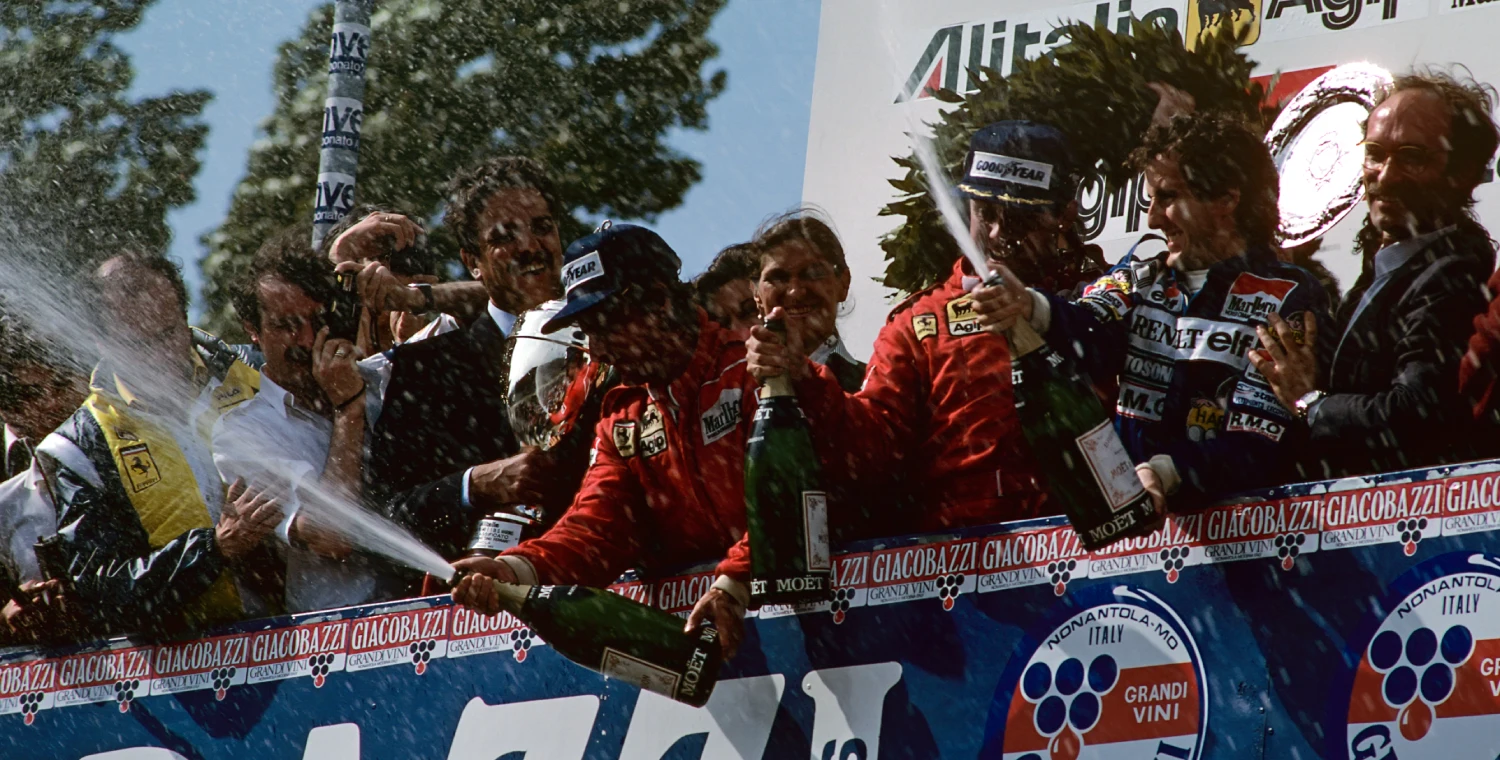
As 1982 wound down, mercifully so did the partnership with Longines, accordingly it was time for Ferrari to speed ahead and find a new cohort—which didn’t take long. In the spring of 1983, “Formula Ferrari,” a joint-venture capsule collection with Cartier, was announced. The arrangement, negotiated by Enzo Ferrari and Alain Dominique Perrin, then-chairman of Cartier (who would go on to become CEO of Cartier’s parent company, Richemont), included quartz and mechanical watches, as well as accessories such as pens, small leather goods and lighters.
Curiously, while the collection was officially “Formula Ferrari by Cartier,” the Cartier name was conspicuously absent from both the products and the packaging—with the Formula Ferrari name front and center.
From a watchmaking perspective, these were rather lackluster timepieces with Seiko quartz movements and Valjoux mechanical calibres. Aesthetically, though, the myriad watch models, as well as the collection’s pens and lighters, veritably scream the ’80s—from the design of the watch cases to the details on the bracelets. The Formula Ferrari bezels were remarkably evocative of the now-iconic period watches from the Roman high jeweler Bulgari (specifically the BVLGARI BVLGARI model), with the distinctive Ferrari logo engraved around the bezel as a prominent motif. The Formula Ferrari by Cartier collection proved so popular it even rated a mention on the cover of the summer 1990 issue of Ferrari World magazine.
As the ’80s gave way to the ’90s, it was Girard-Perregaux’s turn. Ferrari (without Enzo in the driver’s seat) shifted gears, but Formula Ferrari by Cartier has an established place in design folklore as a pioneering partnership of luxury titans.

.webp)
.webp)